✼  ҉ حسام الـבین شـ؋ـیعیان ҉  ✼

✐✎✐ وبلاگ رسمے و شخصے حسام الـבین شـ؋ـیعیان ✐✎✐

✼  ҉ حسام الـבین شـ؋ـیعیان ҉  ✼

✐✎✐ وبلاگ رسمے و شخصے حسام الـבین شـ؋ـیعیان ✐✎✐

Paul the Apostle

Paul and other missionaries to Gentiles were subject to criticism, abuse, and punishment for drawing people away from pagan cults. Although he showed some flexibility on eating food that had been offered to an idol (1 Corinthians 10:23–30), Paul, a monotheistic Jew, was completely opposed to worship of the idol by eating and drinking in the confines of a pagan temple (1 Corinthians 10:21–22). Thus, his converts had to give up public worship of the local gods. Moreover, since Paul’s converts did not become Jewish, they were, in general opinion, nothing: neither Jew nor pagan. Religiously, they could identify only with one another, and frequently they must have wavered because of their isolation from well-established and popular activities. It was especially difficult for them to refrain from public festivities, since parades, feasts (including free red meat), theatrical performances, and athletic competitions were all connected to pagan religious traditions.

This social isolation of the early converts intensified their need to have rewarding spiritual experiences within the Christian communities, and Paul attempted to respond to this need. Although they had to wait with patience and endure suffering (1 Thessalonians 1:6; 2:14; 3:4), and although salvation from the pains of this life lay in the future (5:6–11), in the present, Paul said, his followers could rejoice in spiritual gifts, such as healing, prophesying, and speaking in tongues (1 Corinthians 12–14). In fact, Paul saw Christians as beginning to be transformed even before the coming resurrection: the new person was beginning to replace the old (2 Corinthians 3:8; 4:16).
Although he placed his converts in a situation that was often uncomfortable, Paul did not ask them to believe many things that would be conceptually difficult. The belief that there was only one true God had a place within pagan philosophy, if not pagan religion, and was intellectually satisfying. By the 1st century, many pagans found Greek mythology lacking in intellectual and moral content, and replacing it with the Hebrew Bible was therefore not especially difficult. The belief that God sent his Son agreed with the widespread view that gods could produce human offspring. The activities of the Holy Spirit in their lives corresponded to the common view that spiritual forces control nature and events.
The teaching of the resurrection of the body, however, was difficult for pagans to embrace, despite the fact that life after death was generally accepted. Pagans who believed in the immortality of the soul maintained that the soul escaped at death; the body, they knew, decayed. To meet this problem, Paul proclaimed that the resurrection body would be a “spiritual body,” not “flesh and blood” (1 Corinthians 15:42–55); see below The return of the Lord and the resurrection of the dead.
Although Paul recognized the possibility that after death he would be punished for minor faults (1 Corinthians 4:4), he regarded himself as living an almost perfect life (Philippians 3:6), and he demanded the same perfection of his converts. Paul wanted them to be “blameless,” “innocent,” and “without blemish” when the Lord returned (1 Thessalonians 3:13; 4:3–7; 5:23; Philippians 1:10; 2:15; Romans 16:19). Paul regarded suffering and premature death as punishment for those who sinned (1 Corinthians 5:5; 11:29–32) but did not believe that punishment of the sinning Christian meant damnation or eternal destruction. He thought that those who believed in Christ became one person with him and that this union was not broken by ordinary transgression. Paul did regard it as possible, however, for people to lose or completely betray their faith in Christ and thus lose membership in his body, which presumably would lead to destruction at the Judgment (Romans 11:22; 1 Corinthians 3:16–17; 2 Corinthians 11:13–15).
Paul’s second distinctive and long-lasting admonition concerns obedience to secular rulers. In his letter to the Romans 13:2–7, he asserted that “whoever resists authority resists what God has appointed, and those who resist will incur judgment” (13:2). In later centuries this passage was used to support the doctrine of the divine right of kings, which maintained that royal power came from God, and gave biblical authority to the church’s teaching of submission to rulers, no matter how unjust they were. Few Christians were willing to stray from Romans 13 until the 18th century, when the Founding Fathers of the United States decided to follow the Enlightenment philosopher John Locke rather than Paul on the question of revolt against unjust rulers.
Pin on Saul/Paul

پولس رسول

In the surviving letters, Paul often recalls what he said during his founding visits. He preached the death, resurrection, and lordship of Jesus Christ, and he proclaimed that faith in Jesus guarantees a share in his life. Writing to the Galatians, he reminded them “it was before your eyes that Jesus Christ was publicly exhibited as crucified” (Galatians 3:1), and writing to the Corinthians he recalled that he had known nothing among them “except Jesus Christ, and him crucified” (1 Corinthians 2:2). According to Paul, Jesus’ death was not a defeat but was for the believers’ benefit. In accord with ancient sacrificial theology, Jesus’ death substituted for that of others and thereby freed believers from sin and guilt (Romans 3:23–25). A second interpretation of Christ’s death appears in Galatians and Romans: those who are baptized into Christ are baptized into his death, and thus they escape the power of sin (e.g., Romans 6). In the first case, Jesus died so that the believers’ sins will be purged. In the second, he died so that the believers may die with him and consequently live with him. These two ideas obviously coincide (see below Christology).

The resurrection of Christ was also of primary importance, as Paul revealed in his Letter to the Thessalonians, the earliest surviving account of conversion to the Christian movement. Written to Thessalonica in Macedonia possibly as early as 41 CE and no later than 51—thus no more than 20 years after Jesus’ death—the letter states (1 Thessalonians 1:9–10),
Since Jesus was raised and still lives, he could return to rescue believers at the time of the Final Judgment. The resurrection is connected to the third major emphasis, the promise of salvation to believers. Paul taught that those who died in Christ would be raised when he returned, while those still alive would be “caught up in the clouds together with them to meet the Lord in the air” (1 Thessalonians 4:14–18).
These and many other passages reveal the essence of the Christian message: (1) God sent his Son; (2) the Son was crucified and resurrected for the benefit of humanity; (3) the Son would soon return; and (4) those who belonged to the Son would live with him forever. Paul’s gospel, like those of others, also included (5) the admonition to live by the highest moral standard: “May your spirit and soul and body be kept sound and blameless at the coming of our Lord Jesus Christ” (1 Thessalonians 5:23). See below Moral teachings.
Saint Paul the Apostle, 17th century. Artist: Claude Vignon #14847620

St. Paul the Apostle

Although in his own view Paul was the true and authoritative apostle to the Gentiles, chosen for the task from his mother’s womb (Galatians 1:15–16; 2:7–8; Romans 11:13–14), he was only one of several missionaries spawned by the early Christian movement. Some of the other Christian workers must have been quite important; indeed, an unknown minister of Christ established the church at Rome before Paul arrived in the city. Paul treated some of these possible competitors—such as Prisca, Aquila, Junia, and Andronicus—in a very friendly manner (Romans 16: 3, 7), while he looked on others with suspicion or hostility. He was especially wary of Apollos, a Christian missionary known to the Corinthians (1 Corinthians 3:1–22), and he vilified competitors in Corinth as false apostles and ministers of Satan (2 Corinthians 11). He called down God’s curse on competing preachers in Galatia (Galatians 1:6–9) and asserted that some of the Christians in Jerusalem were “false brothers” (Galatians 2:4; compare 2 Corinthians 11:26). Only in the latter two cases, however, is the nature of the disagreement known: Paul’s competitors opposed his admitting Gentiles to the Christian movement without requiring them to become Jewish. The polemical sections of Paul’s letters have been used in Christian controversies ever since.
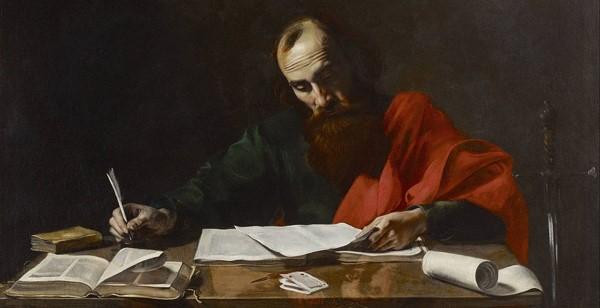

Preparing for Easter with St Paul | Thinking Faith: The online journal of  the Jesuits in Britain

پولس رسول

Paul’s technique for winning Gentiles is uncertain, but one possibility is that he delivered lectures in public gathering places (Acts 17:17 ff.). There is, however, another possibility. Paul conceded that he was not an eloquent speaker (2 Corinthians 10:10; 11:6). Moreover, he had to spend much, possibly most, of his time working to support himself. As a tent maker, he worked with leather, and leatherwork is not noisy. While he worked, therefore, he could have talked, and once he was found to have something interesting to say, people would have dropped by from time to time to listen. It is very probable that Paul spread the gospel in this way.

During the first two centuries of the Roman Empire, travel was safer than it would be again until the suppression of pirates in the 19th century. Paul and his companions sometimes traveled by ship, but much of the time they walked, probably beside a donkey carrying tools, clothes, and perhaps some scrolls. Occasionally they had plenty, but often they were hungry, ill-clad, and cold (Philippians 4:11–12; 2 Corinthians 11:27), and at times they had to rely on the charity of their converts.
Paul wanted to keep pressing west and therefore only occasionally had the opportunity to revisit his churches. He tried to keep up his converts’ spirits, answer their questions, and resolve their problems by letter and by sending one or more of his assistants (especially Timothy and Titus). Paul’s letters reveal a remarkable human being: dedicated, compassionate, emotional, sometimes harsh and angry, clever and quick-witted, supple in argumentation, and above all possessing a soaring, passionate commitment to God, Jesus Christ, and his own mission. Fortunately, after his death one of his followers collected some of the letters, edited them very slightly, and published them. They constitute one of history’s most remarkable personal contributions to religious thought and practice.
110 Saint Paul the Apostle ideas in 2021 | paul the apostle, saint paul,  apostles

St. Paul the Apostle

During the course of his missions, Paul realized that his preaching to Gentiles was creating difficulties for the Christians in Jerusalem, who thought that Gentiles must become Jewish in order to join the Christian movement. To settle the issue, Paul returned to Jerusalem and struck a deal. It was agreed that Peter would be the principal apostle to Jews and Paul the principal apostle to Gentiles. Paul would not have to change his message, but he would take up a collection for the Jerusalem church, which was in need of financial support (Galatians 2:1–10; 2 Corinthians 8–9; Romans 15:16–17, 25–26), though Paul’s Gentile churches were hardly well off. In Romans 15:16–17 Paul seems to interpret the “offering of the Gentiles” symbolically, suggesting that it is the prophesied Gentile pilgrimage to the Temple of Jerusalem, with their wealth in their hands (e.g., Isaiah 60:1–6). It is also obvious that Paul and the Jerusalem apostles made a political bargain not to interfere in each other’s spheres. The “circumcision faction” of the Jerusalem apostles (Galatians 2:12–13), which argued that converts should undergo circumcision as a sign of accepting the covenant between God and Abraham, later broke this agreement by preaching to the Gentile converts both in Antioch (Galatians 2:12) and Galatia and insisting that they be circumcised, leading to some of Paul’s strongest invective (Galatians 1:7–9; 3:1; 5:2–12; 6:12–13).

In the late 50s Paul returned to Jerusalem with the money he had raised and a few of his Gentile converts. There he was arrested for taking a Gentile too far into the Temple precincts, and, after a series of trials, he was sent to Rome. Later Christian tradition favours the view that he was executed there (1 Clement 5:1–7), perhaps as part of the executions of Christians ordered by the Roman emperor Nero following the great fire in the city in 64 CE.
Paul believed that his vision proved that Jesus lived in heaven, that Jesus was the Messiah and God’s Son, and that he would soon return. Moreover, Paul thought that the purpose of this revelation was his own appointment to preach among the Gentiles (Galatians 1:16). By the time of his last extant letter, Romans, he could clearly describe his own place in God’s plan. The Hebrew prophets, he wrote, had predicted that in “days to come” God would restore the tribes of Israel and that the Gentiles would then turn to worship the one true God. Paul maintained that his place in this scheme was to win the Gentiles, both Greeks and “barbarians”—the common term for non-Greeks at the time (Romans 1:14). “Inasmuch then as I am an apostle to the Gentiles, I glorify my ministry in order to make my own people jealous, and thus save some of them” (Romans 11:13–14). In two other places in Romans 11—verses 25–26 (“the full number of the Gentiles [will] come in” and thus “all Israel will be saved”) and 30–31 (“by the mercy shown to you, they too may now receive mercy”)—Paul asserts that he would save some of Israel indirectly, through jealousy, and that Jews would be brought to Christ because of the successful Gentile mission. Thus, Paul’s view reversed the traditional understanding of God’s plan, according to which Israel would be restored before the Gentiles were converted. Whereas Peter, James, and John, the chief apostles to the circumcised (Galatians 2:6–10), had been relatively unsuccessful, God had led Paul through Asia Minor and Greece “in triumph” and had used him to spread “the fragrance that comes from knowing him [God]” (2 Corinthians 2:14). Since in Paul’s view God’s plan could not be frustrated, he concluded that it would work in reverse sequence—first the Gentiles, then the Jews.
Rembrandt, Apostle Paul. - Rembrandt van Rijn as art print or hand painted  oil.